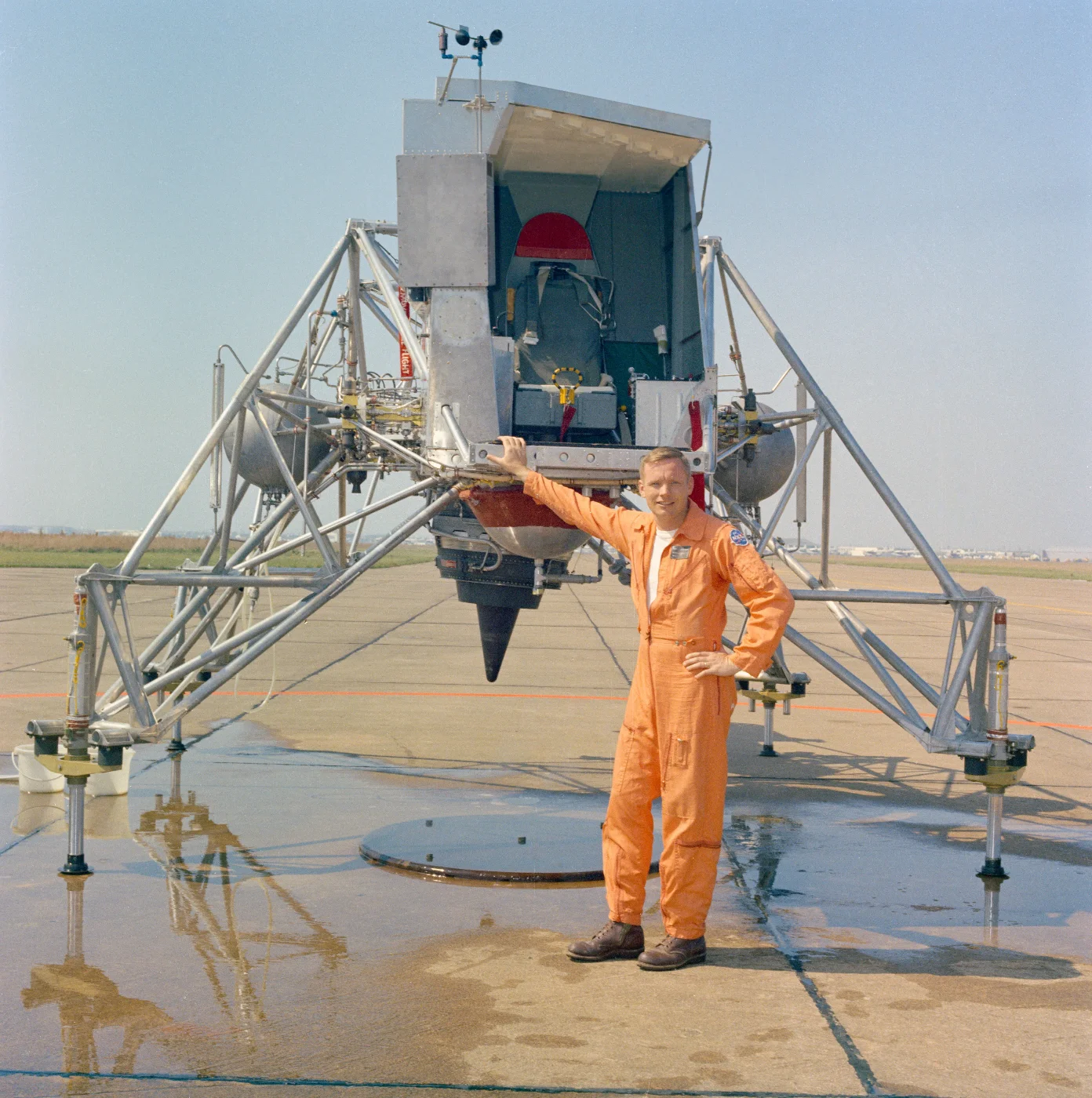
When Neil Armstrong was training for his lunar (1) landing mission, he flew a vehicle on Earth called the LLRV. LLRV stands for Lunar Landing Research Vehicle. The LLRV was a crazy looking flying machine that consisted of(2) a square cockpit that resembled(3) a phone booth, a lot of gas tanks, piping, and framing. It had no outside shell or covering, just mechanims(4) one could see from the outside. Its landing gear(5) made it look like a tall spider. All the Apollo lunar astronauts had to fly it as practice for landing on the moon. It was so strange looking that they called it "the flying bedstead", I guess because, in a way(6), they thought it looked like a bed frame, too.
Neil was an engineer and a test-pilot, more than anything else--so to him, all the planes he flew--after flying in the Navy during the Korean war--were planes being tested and improved. It was a dangerous job. Test pilots routinely died in those days. It happened so often, that when an explosion could be heard, not far from Edward's Air Force Base, in California, their wives just assumed another of their husbands had crashed or his plane had exploded.
When the other Apollo lunar astronauts flew the LLRV, they flew it to gain mastery(7) of lunar landing techniques(8) for their future flights in the Lunar Module(9), the moon ship, they would pilot(10) down to the surface of the moon; they flew to be accurate, safe and comfortable in flight. Not Neil--when Neil flew a new vehicle, such as the X-15 rocket plane(11) or the LLRV, he flew it to the limits of its capacity, not just to make sure he could fly it safely. After all, test pilots who were engineers, like Neil, made design suggestions that went into the final versions(12) of the crafts(13) being built.
One day Neil was flying the LLRV, and he took it up to a few hundred feet. It was not designed for high flying, just for flight to about 1,500 feet up at the maximimum(14)--and in practice, never went higher than 750 feet (229 meter). It had engines that fired up and down at the same time, to create a floating effect or to simulate the lower, one-sixth gravity on the moon. Well, at one point, the engines fired irregularly(15), and the vehicle began to pitch(16), or tip over, and when it was clear to Neil he would not regain control, he fired the jettison(17) engines under his seat and ejected(18), coming back down to Earth under a parachute, but because of the heavy winds and his last minute ejection, Neil was violently dragged through a nearby field. The LLRV hit the ground and exploded nearby.
When he got up and dusted himself off, Neil's helmet was cracked and burned and his moth was bleeding. He had bit his tongue during the sudden blast of his platform and harness out of the LLRV.
A half hour later, Neil was back at his desk, writing a report, not having mentioned this event to the other astronauts in the office. Neil was not the kind of man to give up, despite frightening setbacks. Neil was no stranger to danger. In fact, he escaped death before, during a bombing mission in the Korean War--but that is an adventure for another story. What we can learn from this and other events in Neil's life is that despite setbacks(19), he never gave up(20).
Stay tuned, thanks for reading, and speak like a native,
Carl Atteniese
Vocabulary
- lunar - of or about the moon (whose name is Luna)
- consisted of - composed of , made up of (not made of)
- resembled - looked like
- mechanisms - moving parts of a physical machine
- landing gear - the bars, or "legs", on a plane or spacecraft that have wheels, pads or sleds at their ends, for touching down and resting on the earth
- in a way - partly, partially, by some thinking, by a manner of thinking
- gain mastery - get good at something, achieve expert skill, acquire high proficiency
- techniques - necessary skills for a job or type of work or activity
- Luar Module - the landing and take off parts of a spaceship that lands and takes off from the Moon
- pilot (v) - to operate, drive, steer and maneuver a boat, plane or spacecraft
- X-15 rocket plane - a high performance / high altitude rocket craft dropped from a B-25 airplane for supersonic flight experiments capable of flying slightly beyond the atmosphere and into space
- version - a kind or type of something
- crafts - a vehicles made and used for travel in water, air or space
- maximum - the highest or greatest amount
- irregularly - not regularly, randomly, at mixed amounts or intervals of time
- pitch (aerospace) - the direction corresponding to up and down on the y-axis (When you nod your head to suggest 'yes' you are piching your head
- jettison (aerospace) - the explsove release of a pod, hatch (door) or safety seat away from a plane or spacecraft
- ejected -sent out or away; in aviation, the violent release of a safety seat by rocket motor
- despite - regardless, 'even with _____________' (add a bad development/experience/happening)
- give up / gave up - quit